Publications
The aerial combat strategy of dragonflies
Fabian ST, Yarger AM, Lin HT. (2026) J.R. Soc. Interface 23 240
Male dragonflies engage in aggressive aerial contests to establish breeding territories. Using field stereographic recordings of Trithemis aurora, we examined dragonfly behavioural objectives during these encounters. Unlike predatory pursuits, in which intercept trajectories minimize time-to-contact, male T. aurora steer to keep their opponent in a slightly elevated position within their frontal visual field, modulating speed to avoid direct collision. These contests feature frequent role reversals, with evenly matched rivals alternating between chaser and evader. The manoeuvres observed during these exchanges, including looping and spiralling flight, emerge from the underlying pursuit objectives. During territorial conflicts, males exhibit exceptional agility with centripetal accelerations up to 6g. Despite this high performance, individuals spent approximately one-third of flight time gliding in short bursts, even during close combat. These findings show that complex aerial contests can arise from simple control objectives constrained by sensorimotor limits.


Structural dynamics and neural representation of wing deformation
Locomotor control is facilitated by mechanosensory inputs that report how the body interacts with a physical medium. Effective representation of compliant wing deformations is particularly challenging due to the many degrees of freedom. Structural configurations can constrain the stimulus space, and strategic placement of sensors can simplify computation. Here, we measured and modeled wing displacement fields and characterized spatiotemporal encoding of the wing mechanosensors. Our data show how dragonfly wing architecture prescribes deformation modes consistent across models and measurements. We found that the wing’s state under normal flapping conditions is detected by the spike timing of few sensors, with additional sensors recruited under perturbation. The functional integration of wing biomechanics and sensor placement enables a straightforward solution for information transfer.
Yarger AM, Maeda M, Siwanowicz I, Kajiyama H, Walker SM, Bomphrey RJ, Lin HT. (2025) PNAS 122 46
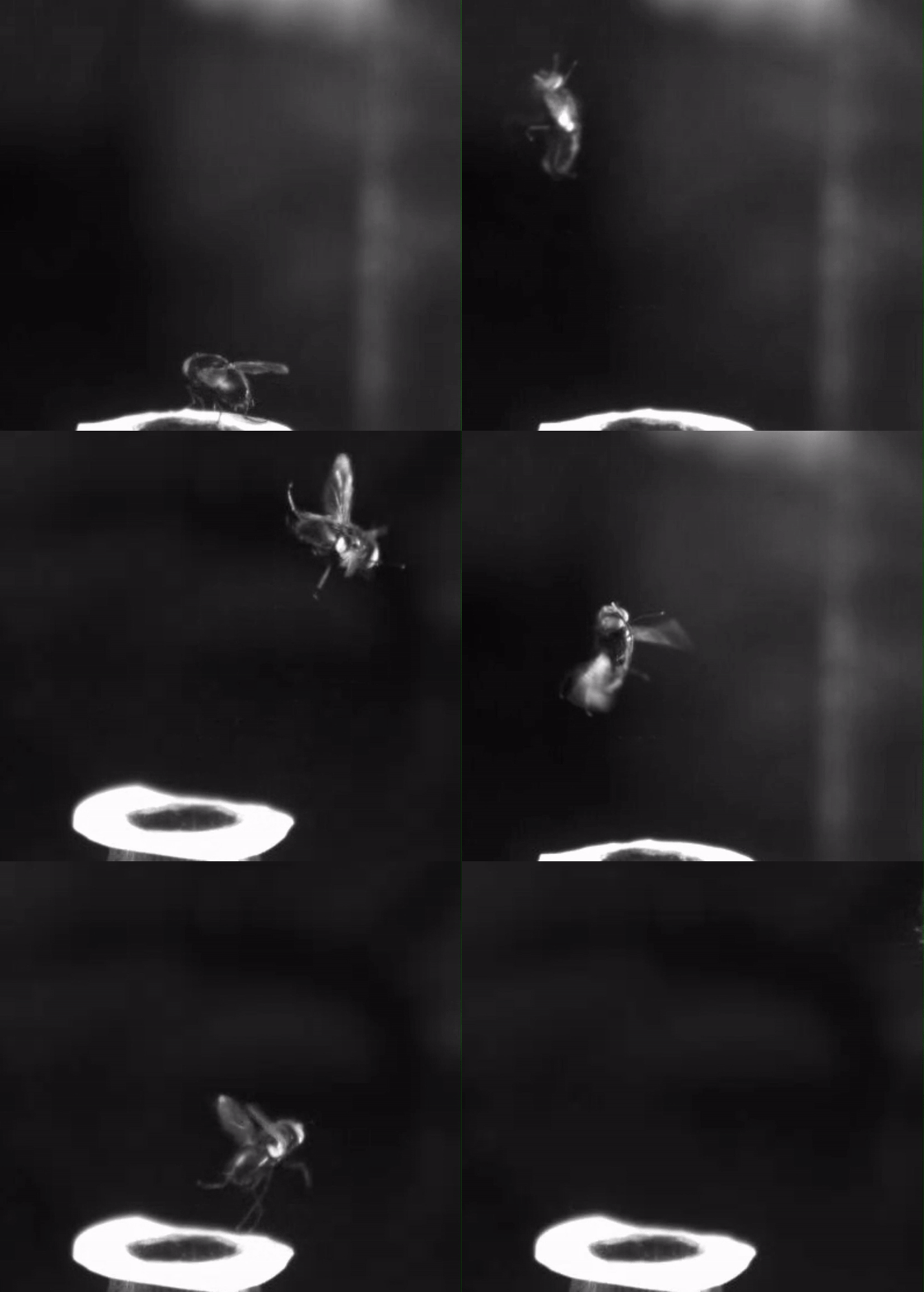
Takeoff diversity in Diptera
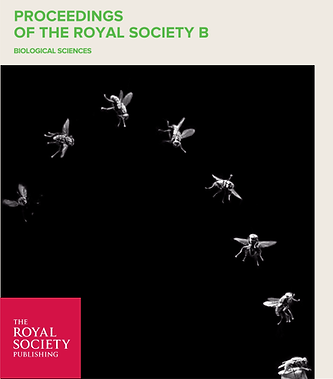
Yarger AM, Jordan KA, Smith AJ, Fox JL. (2021) Proc. Royal Soc. B. 288 1942
The order Diptera (true flies) are named for their two wings because their hindwings have evolved into specialized mechanosensory organs called halteres. Flies use halteres to detect body rotations and maintain stability during flight and other behaviours. The most recently diverged dipteran monophyletic subsection, the Calyptratae, move their halteres independently from their wings and oscillate their halteres during walking. Here, we demonstrate that this subsection of flies uses their halteres to stabilize their bodies during takeoff, whereas non-Calyptratae flies do not. Haltere use allows for greater speed and stability during fast escapes, but only in the Calyptratae clade.

Single mechanosensory neurons encode lateral displacements using precise spike timing and thresholds
Yarger AM, Fox JL. (2018) Proc. Royal Soc. B. 285 1887
During locomotion, animals rely on multiple sensory modalities to maintain stability. External cues may guide behaviour, but they must be interpreted in the context of the animal's own body movements. How do afferent proprioceptor neurons transform movement into a neural code? In flies, modified hindwings known as halteres detect forces produced by body rotations and are essential for flight. We use intracellular electrodes to record from haltere primary afferent neurons during a range of haltere motions. We find that spike timing activity of individual neurons changes with displacement and propose a mechanism by which single neurons can encode three-dimensional haltere movements during flight.
Dipteran halteres: Perspectives on function and integration for a unique sensory organ.
Yarger AM, Fox JL. (2016) Integr Comp Biol. 56 5
The halteres of dipteran insects (true flies) are essential mechanosensory organs for flight. These are modified hindwings with several arrays of sensory cells at their base, and they are one of the characteristic features of flies. Mechanosensory information from the halteres is sent with low latency to wing-steering and head movement motoneurons, allowing direct control of body position and gaze. This review examines how these organs move, encode forces, and transmit information about these forces to the nervous system to guide behavior.

Kinematic diversity suggests expanded roles for fly halteres
Hall JM, McLoughlin DP, Kathman ND, Yarger AM, Mureli S, et al. (2015) Biol Lett. 11 11
The halteres of flies are mechanosensory organs that provide information about body rotations during flight. We measured haltere movements in a range of fly taxa during free walking and tethered flight. Diverse haltere movements were observed during free walking and were correlated with phylogeny. We provide evidence that haltere removal decreases behavioural performance in those flies that move them during walking and open the possibility of multiple functional roles for halteres in different fly behaviours.
Sources and range of long-term variability of rhythmic motor
patterns in vivo
Yarger AM, Stein W. (2015) J Exp Biol. 218 24
The mechanisms of rhythmic motor pattern generation have been studied in detail in vitro, but the long-term stability and sources of variability in vivo are often not well described. The crab stomatogastric ganglion contains the well-characterized gastric mill (chewing) and pyloric (filtering of food) central pattern generators. In vitro, the pyloric rhythm is stereotyped with little variation, but inter-circuit interactions and neuromodulation can alter both rhythm cycle frequency and structure. Using long-term extracellular recordings we identified the range and sources of variability of the pyloric and gastric mill rhythms. In unfed animals the structure remained stable, even when the frequency varied substantially. So, although central pattern generating circuits are capable of producing many patterns, in vivo outputs typically remain stable in the absence of sensory stimulation.

Wikipedia
Primary contributor to the Wikipedia page on halteres
In prep
Yarger AM, Krapp HG. Suppression of self-induced visual motion in butterfly optic flow processing neurons.
Lin J, Supple J, Yarger AM, Krapp HG, Lin HT. Wing mechanosensory modulation of optic flow-sensitive descending neurons in butterflies
Yarger AM; Fabian ST, Zhou R, Chiou R, Chen SI, Lin HT. Dunk and spin: A dragonfly cooling behaviour.
Yarger AM; Barta B, Lin HT. BioLearning: an easy-to-use application for navigating high-dimensional data using neural networks.